AI-Powered Chatbots: How Agentic AI and Voice AI Make Them Next-Gen
Many AI powered chatbots still miss one simple thing. A customer types "Where is my order?" on your website. The chatbot replies with a menu of five buttons, and none of them is about orders.
The customer gives up and calls your support number instead. And now you have two problems: a frustrated customer and a call that the chatbot should have saved.
Today, most businesses already have some kind of chatbot. However, not every chatbot is the same. Some only show menus, some understand what customers write, and a few can actually finish the job and even speak on a call. For this reason, in this blog, I will explain what AI-powered chatbots are, what makes a chatbot next-gen, and how agentic AI and Voice AI fit in. So, let's get started with a quick overview.
AI-powered chatbots: At a glance
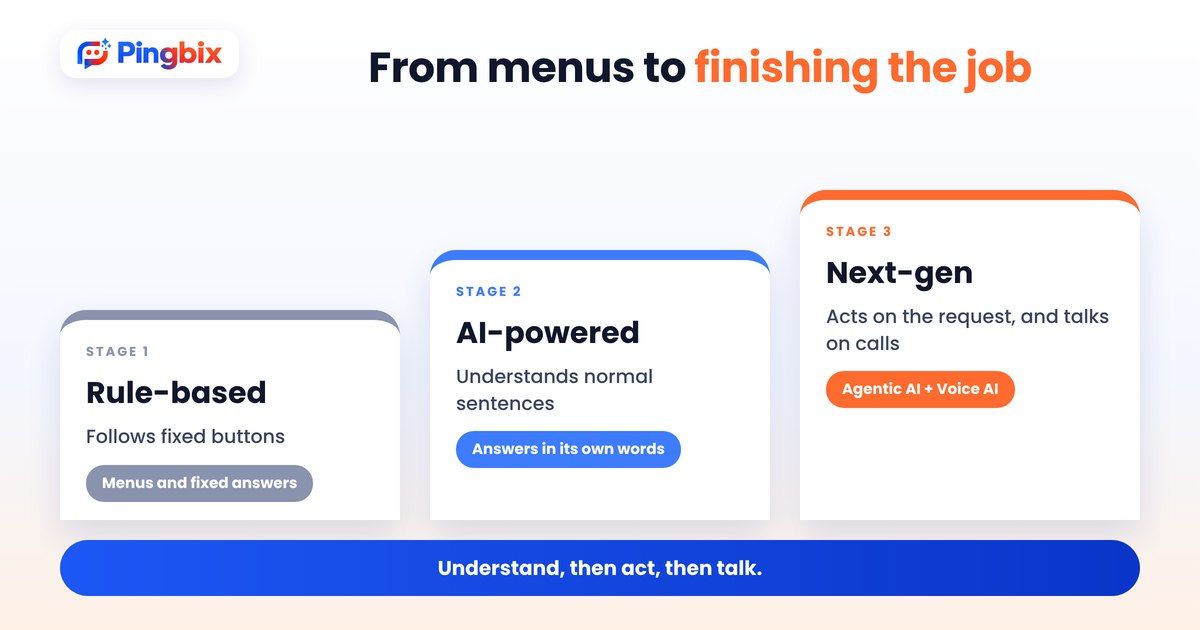
Before diving into the details, let us take a look at the three kinds of chatbots side by side.
| Rule-based chatbot | AI-powered chatbot | Next-gen chatbot | |
|---|---|---|---|
| How it understands | Fixed buttons and keywords | Understands normal sentences | Understands sentences, and also speech on calls |
| What it does | Shows menus and fixed answers | Answers questions in its own words | Answers, and also takes the next steps (agentic AI) |
| Where it works | Website or app chat | Website, WhatsApp and app chat | Chat and phone calls (Voice AI) |
| When it can't help | Stops and repeats the menu | May guess or give a general answer | Passes to a person, with the details collected |
| Best for | A few fixed questions | Common questions in plain language | Routine tasks across chat and calls |
In one line: a rule-based chatbot follows a script, an AI-powered chatbot understands you, and a next-gen chatbot also gets the work done.
But looking at this table, you cannot get a clear idea of what "next-gen" really adds. So, let's check them out in particular:
What are AI-powered chatbots?
An AI-powered chatbot is a chatbot that understands normal language, so the customer doesn't need to press buttons or type exact keywords. A customer can write "my parcel hasn't come yet" or "order kab aayega", and the chatbot works out what they mean.
This is the big difference from a rule-based chatbot. A rule-based one only knows the paths you drew for it. An AI-powered one can handle the many different ways people ask the same thing.
However, understanding is only the first step. Many AI-powered chatbots still stop at answering. They can tell the customer how returns work, but they can't start the return. And they usually live only in the chat window, so when the customer calls, the chatbot is not there. That's where the next-gen idea comes in.
What makes a chatbot next-gen?
A chatbot becomes next-gen when it gets two upgrades: it can take action, and it can talk.
Upgrade 1: Agentic AI, so the chatbot finishes the task
Agentic AI means the chatbot doesn't stop at an answer. It works out the steps needed to solve the customer's request and carries them out, within the limits you set.
Here is a simple example. A customer says, "I want to change my delivery address." A normal AI-powered chatbot explains how to do it. A chatbot with agentic AI checks the order, sees that it hasn't shipped, asks for the new address, updates it, and tells the customer it's done.
If you want to know how this is different from the AI that writes text and answers, read our post on agentic AI vs generative AI.
The important part is the limits. You decide what the chatbot is allowed to do, such as check an order or book a slot, and what must always go to a person, such as refunds above a set amount.
Upgrade 2: Voice AI, so the chatbot can talk
Many customers don't want to type. They call, and they speak in Hindi, English or a mix of both. Voice AI lets the same kind of chatbot listen to a caller, understand what they need and reply by voice.
In simple words, it is a chatbot that you can talk to. First, it turns speech into text. Then it understands the request, and then it replies in a natural voice. If you want to see how the first step works in Hindi, we explained it in our guide on speech to text in Hindi.
The benefit is that a customer gets the same help whether they chat on WhatsApp, type on your website or pick up the phone. It can also replace the old IVR menu of "press 1 for this, press 2 for that", so callers can just say what they want.
Why next-gen chatbots matter for your business
Here is what changes when a chatbot can understand, act and talk:
- Customers get answers at any hour. A question at 11 pm gets a reply at 11 pm, not the next morning.
- Routine work leaves your team. Order status, appointment changes and payment reminders are repeated all day. A chatbot can take these, so your team spends time on the cases that need a person.
- Customers use the language they are comfortable with. They can write or speak in Hindi, English or a mix, and the chatbot follows. We have covered this in our guide on multilingual customer support.
- Chat and calls feel connected. The customer doesn't have to repeat the story when they move from chat to a call.
- You learn what customers ask. Every chat and call can be saved as text, so you can see which questions come up most and where customers get stuck.
For a closer look at the chat side, read our post on how an AI chatbot on WhatsApp improves customer experience.
A use case: a customer asks about a missed delivery
Let's say a customer's parcel was not delivered, and they want to know what happened. Here is how it goes with each kind of chatbot.
With a rule-based chatbot:
- The customer sees a menu and picks "Track order".
- The chatbot asks for the order ID and shows a tracking link.
- The link says "delivery attempted", and the customer has no idea what to do next. So they call support.
With a next-gen chatbot:
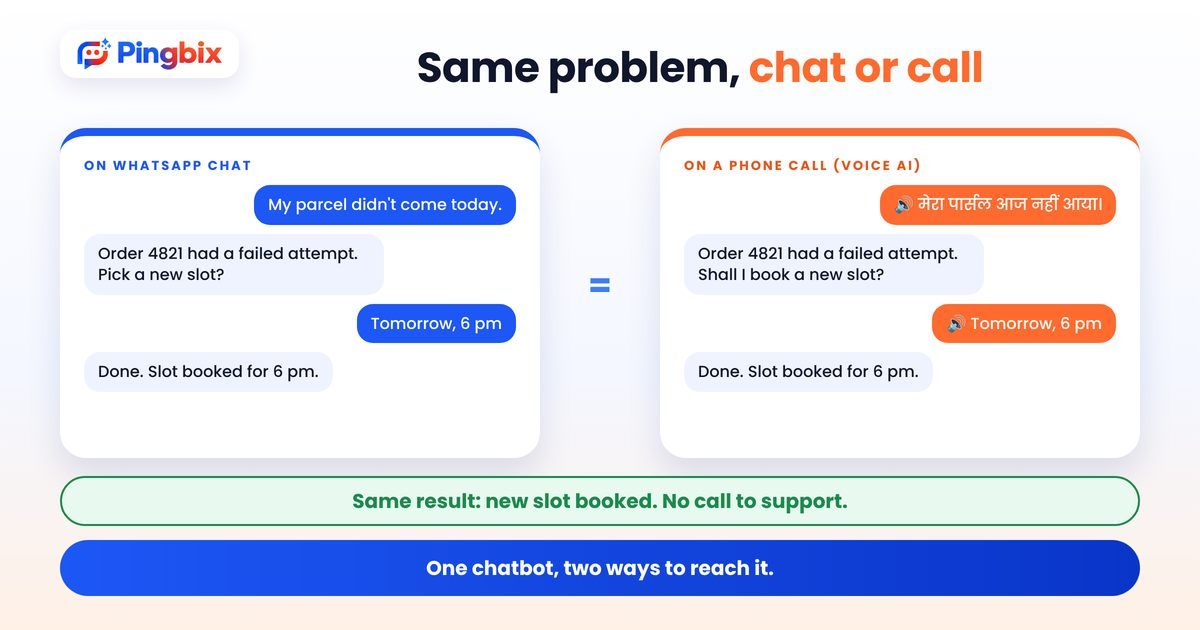
- The customer writes, "My parcel didn't come today." The chatbot understands it, and asks for the order number.
- It checks the order, sees the failed attempt and offers a new delivery slot.
- The customer picks a slot, and the chatbot books it and confirms.
- If the customer prefers to call, Voice AI picks up, understands the same request in Hindi and completes the same steps.
- If the customer is upset or asks for something outside the rules, the chatbot passes the chat or call to your team, with the details already collected.
Same customer, same problem. One ends with a phone call to support. The other ends with a booked slot. We have written about a similar flow for calls in our post on AI handling hospital appointment calls, and the same idea works across retail, finance, healthcare and education.
Not sure which of your customer questions a chatbot could handle?
Tell us what your customers ask most, and we will help you pick the right place to start.
Where AI-powered chatbots fall short
Chatbots are useful, but they are not perfect. Keep these points in mind:
- They can give a wrong answer. If the chatbot doesn't have the right information, it may guess. Keep its answers based on your own approved content.
- They are only as good as your data. If your order system is slow or your help content is out of date, the chatbot will be too.
- Actions need clear limits. A chatbot that can change orders or book slots must have rules on what it can and can't do.
- Voice needs testing. Phone lines are noisy, and accents and mixed Hindi and English can confuse the system. Test it on real calls before you go live.
- Private data needs care. Customers may share phone numbers, addresses or health details. Decide what is saved and who can see it.
- Some cases need a person. An upset customer or a complicated case should always have an easy way to reach your team.
For this reason, it's best to start small, with a few routine tasks, and always keep a way to hand over to a person.
How to start with a next-gen chatbot
A few simple steps help:
- List your most repeated questions. Look at your chats and calls from the last month. Order status, timings and payment reminders usually come first.
- Pick two or three tasks. Choose the ones that are routine and have clear rules.
- Decide what the chatbot can do, and what it can't. For example, it can check an order, but refunds go to your team.
- Add voice only where calls are heavy. If many customers call for the same few things, that is where Voice AI helps most.
- Test with real conversations. Use real customer messages and call recordings, and fix the gaps before launch.
- Review every week. Read the chats and calls where the chatbot failed, and improve from there.
So, which chatbot does your business need?
It depends on what your customers ask for.
- If you have a few fixed questions, a rule-based chatbot is enough.
- If customers ask in many different ways, you need an AI-powered chatbot that understands normal language.
- If you want the work finished, and not only answered, you need agentic AI.
- If many customers call instead of chat, you need Voice AI on top.
Most businesses move step by step, and that's fine. So, start with the problem you have today, and add more once the first part works.
Pingbix builds customised AI solutions for customer conversations, such as an AI chatbot and Voice AI, and works with the channels your customers already use, including WhatsApp, SMS and calls. We start with the questions your customers ask most, then decide what the chatbot handles and where a person steps in. If you want to see how follow-ups work in practice, read about AI follow-up calls for clinics and salons.
Want to see how this would work for your own customers, not a generic demo, but built around your use case?