Agentic AI vs Generative AI: What's the Difference and When to Use Each
A customer messages your business: "My order is three days late. What's going on?"
Today, most businesses try to answer this kind of message with AI. For this reason, you will hear two terms all the time: generative AI and agentic AI. They sound alike, but they do very different jobs.
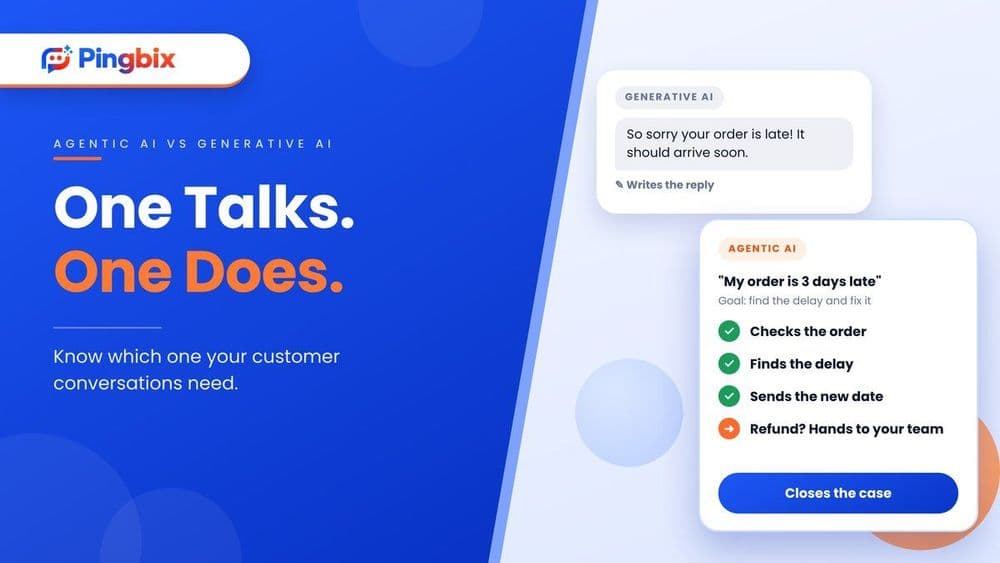
Generative AI can write a polite reply in seconds. But then it stops, and someone on your team still has to check the order, find the delay and fix it. Agentic AI can do those steps itself.
That being said, picking between the two isn't always easy. For that reason, in this article, I will compare agentic AI vs generative AI in plain words, with an example you can use. So, let's get started with a quick overview.
Agentic AI vs generative AI: At a glance
Before diving into the details, let us take a look at the two side by side.
| Generative AI | Agentic AI | |
|---|---|---|
| Main job | Creates content | Completes a task |
| Starts when | You send a prompt | You set a goal, or an event triggers it |
| Output | Text, images, code, audio | A finished action or result |
| Steps | One response at a time | Plans and runs many steps |
| Works with your systems | Usually not, unless connected | Yes, it reads and updates them |
| Your role | Review each output | Set the rules, check the results |
| Main risk | Wrong or made-up content | Wrong action taken in your systems |
| Example | Drafts a reply to a complaint | Checks the order, fixes it, updates the customer |
In one line: generative AI answers, and agentic AI acts.
But looking at this table, you cannot get a clear idea of which one to go for. So, let's check them out in particular:
What is generative AI?
Generative AI is AI that creates new content from a prompt. That content can be text, images, code, audio or video. It learns patterns from a huge amount of data, then produces something new that fits your request.
You can use it to write emails, summarise long documents, translate messages and answer questions through an AI chatbot. Its limit is that it waits for you. You give a prompt, it gives an answer, and the next step is yours.
What is agentic AI?
The agentic AI meaning is simple: AI that can pursue a goal with limited supervision. You tell it what you want done, and it works out the steps, carries them out and checks if they worked.
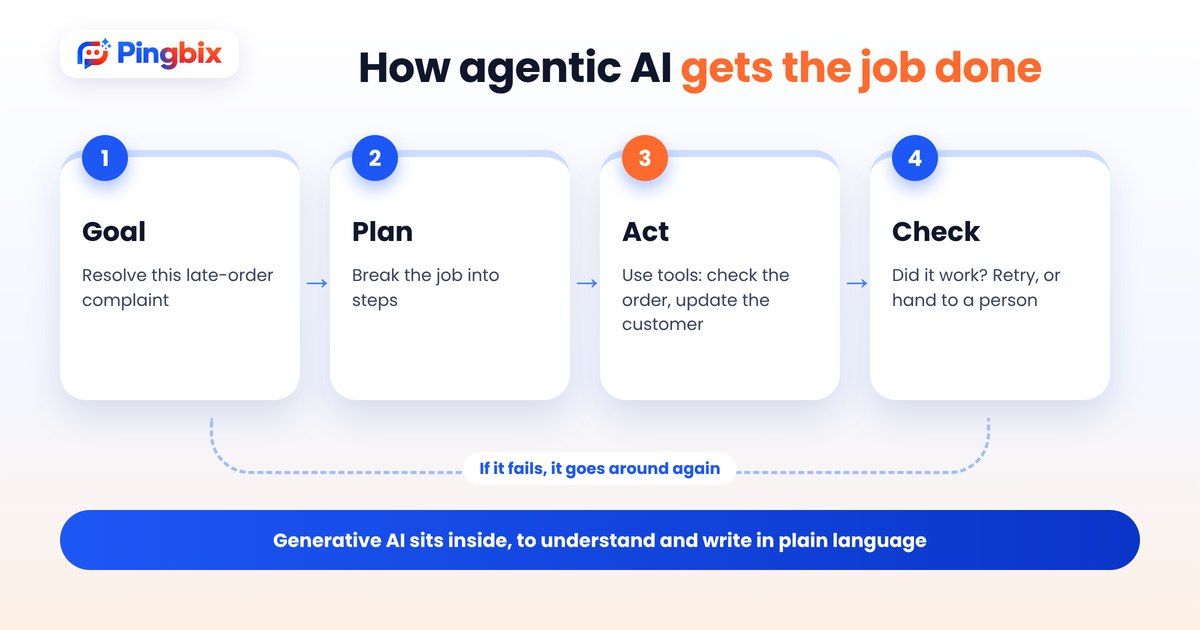
Most agentic AI systems have four parts: a goal, a plan, tools to take action, and a check at the end. It's not a separate invention either. Most agentic AI uses generative AI to understand language. The "agentic" part is the loop of planning, acting and checking that sits around it.
You may also see "AI agents" in this conversation. An AI agent is one piece of software that handles a task, while agentic AI is the wider approach of building systems that pursue goals and act. People mix the two terms often, so it's worth asking a vendor what their product actually does.
How they work
The way an AI works decides how much it can do for you. It's a good first thing to look at, on top of what it can write or say.
Generative AI
Generative AI works one request at a time. You ask, it answers. For example, you can ask it to draft a reply to a late-delivery complaint, and it gives you a clear, friendly message.
It doesn't plan ahead or remember the goal once the answer is done. If you want a second step, you have to ask for it.
Agentic AI
Agentic AI works toward a goal. Given "resolve this late-delivery complaint," it breaks the job into steps, such as checking the order, finding the cause and updating the customer. It then runs those steps and looks at the result.
If something fails, it can try another way or pass the case to a person.
What they do in your systems
Having smart replies is one thing, but what the AI can actually touch in your business matters just as much.
Generative AI
Generative AI usually works on its own, with the information it was given. It can explain your delivery policy, but it can't see where this customer's parcel is.
Furthermore, it doesn't change anything in your systems. The reply goes out, and the order stays exactly as it was.
Agentic AI
Agentic AI connects to your tools, like your order system, calendar or CRM. It can read the data and update it too. For instance, it can check a courier status, move an appointment or log a note on a customer's record.
Hence, the customer gets the result, and not only a reply about the result.
Role of your team
Whichever one you pick, your team's job changes. It helps to know how before you start.
Generative AI
With generative AI, someone reviews each output. You read the draft, fix it if needed and send it. The AI saves time, but a person is still in every step.
Agentic AI
With agentic AI, your team sets the rules and checks the results. For example, you can decide that the AI may give a new delivery date, but any refund above a set amount goes to a person.
Calls that need judgment, like disputes or upset customers, should reach a person fast, with the details already collected.
Risks
Both can go wrong. The difference is how the mistake shows up.
Generative AI
The main risk is a wrong or made-up answer. The good news is that you can often catch it before it reaches the customer, because someone reviews the output.
Agentic AI
The main risk is a wrong action. Since the AI acts in your systems, a mistake has already happened by the time you see it. For this reason, clear limits, a human handoff and a check on what the AI did (not only what it said) matter so much.
It also helps to start small. Gartner has predicted that over 40% of agentic AI projects will be cancelled by the end of 2027, and you can read their prediction here. One clear, routine task is a good first project. Keep customer data privacy in mind too, especially in contact centers.
A use case: a customer asks "where is my order?"
Let's go back to the customer from the start. They write on WhatsApp: "My order is three days late. What's going on?"
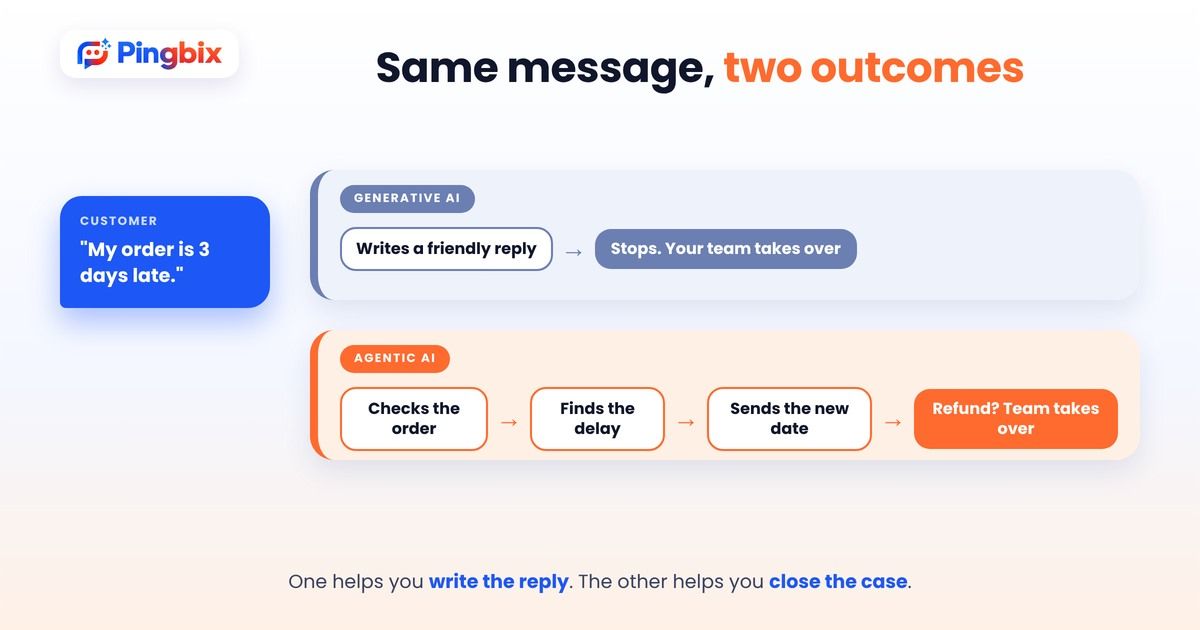
With generative AI:
- It reads the message and writes a friendly reply.
- It can say how long deliveries usually take, using your help content.
- It can't see this customer's order. So the reply is polite, but it doesn't solve anything, and an agent still has to take over.
With agentic AI:
- It reads the message and understands the goal: find out why the order is late and fix it.
- It checks the order and the courier status in your systems.
- It sees the parcel is delayed, and sends the customer the new delivery date.
- If the customer asks for a refund above the limit you've set, it stops and passes the case to a person, with the details already collected.
- It records what happened, so nobody has to ask the customer again.
Same customer, same message. One AI helps you write the reply. The other helps you close the case. We've also written about a similar call, in our post on AI handling hospital appointment calls, which ends in a booked slot instead of a note for someone to follow up.
Not sure which parts of your customer conversations need a smart reply, and which need AI that does the work?
Tell us what your team handles today, and we'll help you sort it out.
Agentic AI vs generative AI: Which one do you need?
So, which one is the best for your business? The answer depends on the job you need done.
- If the job is to write or explain something, generative AI is enough. Think FAQs, drafts and summaries.
- If the job is to get something done in your systems, you need the agentic approach. Think bookings, status checks and follow-ups.
- If a mistake would be costly, add a person's approval before the AI acts.
Most businesses end up using both. Generative AI covers the conversation, and the agentic part handles the steps behind it. So, start by looking at your own routine, high-volume tasks, such as order status updates or appointment reminders, and build from there.
Pingbix builds customised AI solutions for customer conversations, such as Voice AI and an AI chatbot, and works with the channels your customers already use, including WhatsApp, SMS and calls. We start with the task you want handled, then decide how much the AI should do on its own and where a person steps in. For example, our multilingual Voice AI can take routine calls in the customer's language, and pass the rest to your team. These ideas apply across industries, such as healthcare, finance and retail.
That being said, "agentic" and "generative" are only labels. What matters is the task. Pick one, test it and grow from there.
Want to see how this would work for your own customer conversations, not a generic demo, but built around your actual use case?