Omnichannel Retail Strategy for Indian D2C Brands: Turning Every Channel Into One Journey
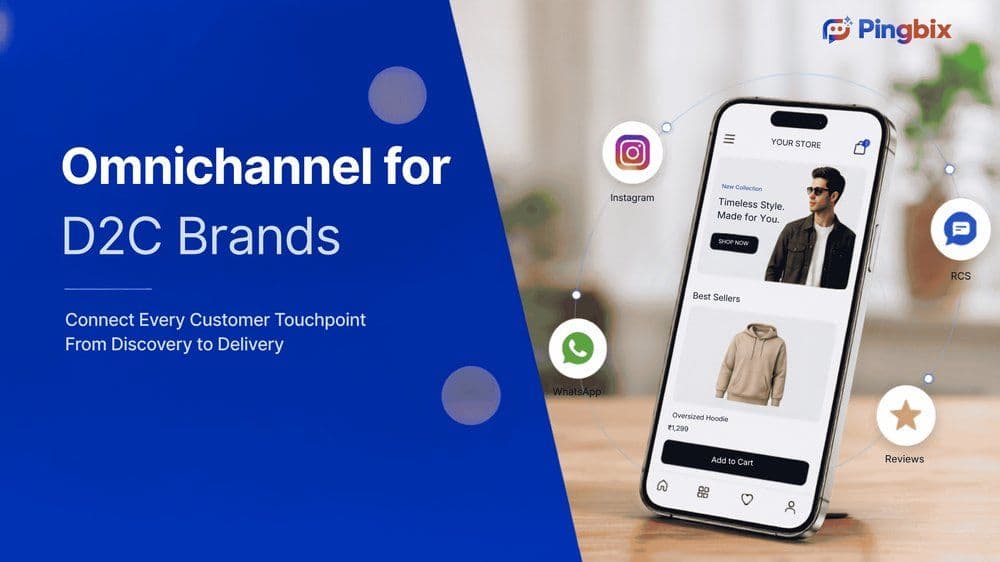
Picture this. A customer sees your product on Instagram, taps through to WhatsApp to ask a question, adds two items to their cart on your app, and then goes quiet for two days. Sound familiar? This is the exact moment where most Indian D2C brands lose the sale, not because the customer stopped being interested, but because nobody followed up on the channel the customer was actually using. That's the problem an omnichannel retail strategy is meant to solve. Not "be everywhere," but connect the channels you're already on so the customer never has to repeat themselves, and you never lose the thread. We've written before about individual pieces of this puzzle, like how [WhatsApp Flows](#) turn chat into bookings and how [RCS solves the WISMO problem](#) in logistics. This post ties it all together, because the real advantage isn't any single channel. It's how well they talk to each other. ## What omnichannel actually means (and where most brands get it wrong) Here's a distinction I see brands miss constantly: using five channels is not the same as having an omnichannel strategy. - **Single channel** means you sell through one thing, say, just your website or just a physical store. Simple, but limited. - **Multichannel** means you're on WhatsApp, Instagram, email, and your website, but each one runs separately. A customer who messages you on WhatsApp and then emails support has to explain their issue all over again. - **Omnichannel** means all of that is connected. The customer can move from Instagram to WhatsApp to a phone call, and your team already has the full context, every time. For Indian D2C brands specifically, this isn't a nice-to-have. It's the difference between recovering a cart and watching it disappear, and between converting a COD order and eating the cost of a return-to-origin. ## Why this matters more in India than almost anywhere else A few things make the Indian retail landscape different from the global playbooks most CPaaS blogs are written for. **COD is still enormous, and RTO eats margins.** Cash-on-delivery remains a dominant payment mode across Tier 2 and Tier 3 India, and with it comes one of the most expensive problems in Indian e-commerce: return-to-origin. A customer who never confirms their order, never gets reminded, and never gets a delivery-day nudge is a customer who's far more likely to reject the parcel at the door. **WhatsApp is the default, not an add-on.** For most Indian shoppers, WhatsApp isn't one channel among many, it's the channel they trust first. A brand that only uses WhatsApp for marketing blasts, and not for order confirmation, delivery updates, or support, is leaving trust on the table. **Regional language isn't optional.** A customer in Coimbatore or Indore responding well to a message doesn't just depend on which channel you used. It depends on whether that message met them in a language they're comfortable with. **Festive spikes break brittle systems.** Diwali, Big Billion Days, End of Reason Sale, these aren't just spikes in orders. They're spikes in "where is my order" queries, delivery reschedules, and support volume, all at once. A disconnected stack buckles exactly when you need it most. ## What a connected customer journey actually looks like Let's walk through what this looks like in practice, using a journey we see constantly with Indian D2C brands. **Awareness.** A customer sees your Instagram ad and taps a click-to-WhatsApp button instead of visiting your website. They're already telling you their preferred channel, don't ignore that signal. **Consideration.** On WhatsApp, they ask about sizing or COD availability. They browse a bit, add items to cart on your app, then go quiet. Two days later, a WhatsApp reminder about their cart, in their preferred language, brings them back. **Purchase.** They choose COD at checkout. Instead of hoping they'll accept the parcel, you send a WhatsApp confirmation asking them to verify the order, exactly the kind of interaction that cuts RTO rates meaningfully. If they don't respond, a follow-up SMS backs it up, since SMS still lands even when data is patchy. **Fulfillment.** As the order moves, an RCS delivery update replaces the generic "your order has been shipped" text with a rich, trackable message, reducing inbound WhatsApp queries asking the same question your logistics team already answered. **Post-purchase.** A day after delivery, a WhatsApp message asks for a quick review. If they had a support question along the way, that same conversation thread already had the full order context, no repeating themselves to a new agent. That's five channels working as one journey, not five separate campaigns hoping to catch the same customer at different times. Running your D2C brand across Instagram, WhatsApp, SMS, and RCS, but still handling each one separately? See what a connected journey looks like on Pingbix, built specifically around COD, RTO, and regional-language reality in India. **[[Book a Demo](lhttps://pingbix.com/contact)]** ## How to actually build this, step by step **Start with your data, not your channels.** Before picking tools, understand where your customers actually are, COD-heavy pin codes, WhatsApp-first segments, and repeat buyers who respond better to email. Your channel mix should follow your customer data, not the other way around. **Map where you're losing people today.** Look at your funnel honestly. Is it cart abandonment? RTO on COD orders? Repeated "where is my order" tickets? Each of these points to a different channel fix, not a blanket "add more channels" approach. **Use the right channel for the right moment.** WhatsApp for cart recovery and COD confirmation. SMS as the reliable backup when data or app notifications fail. RCS for rich delivery updates. Email for receipts and post-purchase nurture. Don't force every message onto one channel just because it's trendy. **Connect your data, not just your channels.** A chatbot that doesn't know a customer already messaged support yesterday isn't omnichannel, it's just another disconnected tool. Your CRM, your messaging platform, and your support inbox need to share context. **Test what actually moves the needle.** COD confirmation message timing, cart recovery delay, review request timing, these are all testable. Small changes in when and how you reach out often move RTO and conversion numbers more than adding a new channel ever will. ## Where Pingbix fits into this Everything in that journey above, [WhatsApp](/whatsapp-api) for cart recovery and COD confirmation, SMS as your reliable fallback, RCS for delivery updates, and a chatbot that carries context across the conversation, is something we already help D2C and retail brands run from one platform, instead of stitching together five different tools that don't talk to each other. ## The bottom line An omnichannel retail strategy isn't about adding more channels. It's about making sure the ones you already use actually work together, so a customer never has to repeat themselves, and you never lose a sale just because the follow-up landed on the wrong channel. For Indian D2C brands dealing with COD, RTO, and festive-season spikes, that connection isn't a nice-to-have, it's the difference between a recovered cart and a lost one. If your channels are still working in silos, that's exactly the kind of gap Pingbix can help you close.